
Workflow automation

How can enterprise software aid large organization growth?
Large organizations face continuous pressure to grow, adapt, and remain competitive in an ever-evolving market. Achieving this growth often hinges on the ability to manage complex operations, make informed decisions, and efficiently utilize vast resources. This is where enterprise software plays a pivotal role. These sophisticated applications are designed to support and integrate various business processes across departments, providing a unified platform for managing everything from finances and human resources to supply chains and customer relationships. By centralizing data and automating tasks, enterprise software creates a foundation for sustained expansion and operational excellence.

Overview
- Enterprise software integrates core business functions, providing a centralized system for data and operations.
- It significantly improves operational efficiency by automating routine tasks and streamlining workflows.
- Advanced analytics and reporting capabilities within these systems empower data-driven strategic decision-making.
- Enterprise software solutions are built to scale, supporting an organization’s expansion in size, scope, and geographic reach.
- They enhance collaboration across departments, breaking down silos and fostering a more connected workforce.
- Robust security features protect sensitive data, which is crucial for large organizations operating in various regulatory environments, including the US.
- By freeing up resources from manual tasks, these systems allow teams to focus on innovation and value-added activities.
Streamlining Operations with Enterprise Software
For large organizations, operational efficiency is not just an advantage; it is a necessity. The sheer volume of transactions, employees, and processes can quickly become unwieldy without robust systems in place. **Enterprise software**, such as Enterprise Resource Planning (ERP) systems, integrates functions like finance, human resources, manufacturing, and supply chain management into a single platform. This integration eliminates data silos, reduces manual data entry errors, and automates many routine tasks that previously consumed significant time and resources. For example, an ERP system can automatically reconcile invoices with purchase orders, track inventory levels in real-time, and manage payroll across thousands of employees. By simplifying these complex workflows, organizations can reduce operating costs, optimize resource allocation, and accelerate cycle times for critical business processes. The result is a leaner, more agile operation capable of handling increased demand and supporting future growth without proportional increases in administrative overhead.
Driving Data-Informed Decisions with Enterprise Software
In today’s data-rich environment, the ability to collect, analyze, and act upon insights is paramount for growth. **Enterprise software** platforms are equipped with powerful Business Intelligence (BI) and analytics tools that process vast amounts of operational data into meaningful, actionable information. These systems provide executives and managers with dashboards, reports, and predictive models that offer a clear view of performance across various metrics—from sales trends and customer behavior to supply chain bottlenecks and employee productivity. For instance, a Customer Relationship Management (CRM) system can track customer interactions, purchase history, and preferences, allowing sales and marketing teams to tailor strategies for higher conversion rates. This data-driven approach removes guesswork from strategic planning, enabling organizations to identify new market opportunities, optimize product offerings, mitigate risks, and make proactive decisions that directly contribute to sustainable growth.
Enabling Scalability and Adaptability with Enterprise Software
Growth often brings
Automating Workspaces: Trends Shaping the Future
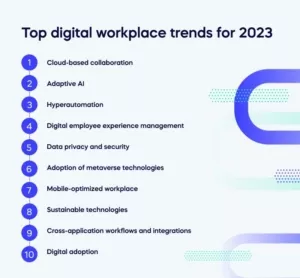
Automating Workspaces: Trends Shaping the Future
Workplace automation is undergoing a transformative evolution, reshaping the way businesses operate and enhancing efficiency. In this article, we delve into the current trends in workplace automation, shedding light on the advancements that are shaping the future of work.
Rise of Robotic Process Automation (RPA)
Robotic Process Automation (RPA) is at the forefront of workplace automation trends. RPA involves using software robots or “bots” to automate repetitive and rule-based tasks. From data entry to invoice processing, RPA streamlines workflows, reduces errors, and allows employees to focus on more strategic and creative aspects of their roles.
Integration of Artificial Intelligence (AI) and Machine Learning (ML)
The integration of Artificial Intelligence (AI) and Machine Learning (ML) is a game-changer in workplace automation. AI and ML algorithms enable systems to learn from data, adapt to changing scenarios, and make intelligent decisions. From predictive analytics for employee performance to chatbots for customer service, the applications of AI and ML are diversifying across various business functions.
Workflow Automation for Increased Productivity
Workflow automation is becoming increasingly sophisticated, encompassing entire business processes. This trend involves the automation of end-to-end workflows, allowing for seamless collaboration between different departments. By reducing manual handovers and delays, workflow automation enhances overall productivity and accelerates time-to-market for products and services.
Employee Self-Service Portals
Empowering employees through self-service portals is a rising trend in workplace automation. These portals enable employees to access information, submit requests, and perform various HR-related tasks independently. Employee self-service not only enhances efficiency but also contributes to a more engaging and satisfying employee experience.
Digital Adoption Platforms (DAPs) for Skill Development
With the rapid evolution of technology, ensuring that employees can effectively use new tools and platforms is crucial. Digital Adoption Platforms (DAPs) guide users through software interfaces, providing real-time assistance and tutorials. As businesses adopt new technologies, DAPs are instrumental in reducing learning curves and fostering quick and effective skill development.
Internet of Things (IoT) for Smart Workspaces
The Internet of Things (IoT) is transforming workspaces into intelligent environments. Connected devices and sensors enable the gathering of data on workplace usage, temperature, and lighting conditions. This data-driven approach allows organizations to optimize office layouts, improve energy efficiency, and enhance the overall work environment.
Enhanced Security with Automation
Workplace automation trends are also addressing the growing importance of cybersecurity. Automated security systems use AI to detect and respond to potential threats in real-time. By continuously monitoring network activities and identifying anomalies, these systems strengthen overall cybersecurity measures, safeguarding sensitive data and ensuring compliance with industry regulations.
Hybrid Work Models and Virtual Collaboration Tools
The rise of remote and hybrid work models has accelerated the adoption of virtual collaboration tools. Workplace automation trends are focusing on creating seamless virtual environments, integrating video conferencing, project management, and communication tools. This ensures that teams can collaborate effectively regardless of their physical location.
Emphasis on Employee Well-Being and Experience
Automation is not only about tasks; it also extends to enhancing the overall employee experience. Workplace automation